
Nobel Prize meets PSI research
Villigen, 06.10.2026 — This year’s Nobel Prize in Physiology or Medicine honours optogenetics – a biotechnological method through which light can be used to selectively control processes in cells. At the Paul Scherrer Institute PSI, researchers are working to extend this principle beyond nerve cells to other cell types and organs. This could lead to a new generation of optogenetic tools – even to the point of being able to control biological processes with light instead of drugs in the future.

This year’s Nobel Prize in Physiology or Medicine goes to Peter Hegemann, Karl Deisseroth, and Georg Nagel for their discoveries concerning light-gated ion channels and optogenetics. Hegemann and Nagel discovered channelrhodopsin, a protein that makes single-celled algae light-sensitive; Deisseroth succeeded in transferring this protein to nerve cells and selectively activating them with light.
With this the three researchers created the basis for a method by which nerve cells can be precisely controlled and investigated, which has fundamentally changed neuroscience. Now PSI researchers want to extend this principle to other types of cells.
Beyond nerve cells
Up to now, optogenetics has relied on light-gated ion channels to control electrical signals – this works particularly well in nerve cells. However, many other processes in the body are not based on electrical impulses, but rather on complex signalling pathways within cells. If these too could be switched on and off with light, optogenetics could be applied to numerous other cell types and biological processes.
A team led by Gebhard Schertler from the PSI Center for Life Sciences is developing light-sensitive proteins into molecular switches for this purpose. “Classical optogenetics alters the ion balance in nerve cells – we, on the other hand, could activate signalling cascades in the brain and other organs, and this is something completely new,” Schertler explains. Among other things, the technique could one day help researchers better understand many diseases and perhaps even develop new drugs.

The second optogenetics revolution
Within the framework of the project “Switchable rhodOpsins in Life Sciences”– funded by an ERC Synergy Grant – Gebhard Schertler, together with Nobel laureate Peter Hegemann and Rob Lucas from the University of Manchester, is working to develop new optogenetic proteins that can be used in other cells and for other functions, in virtually any organ. In the research community there is talk of a possible second revolution in optogenetics.
So-called G-protein-coupled receptors, GPCRs for short, are an ideal target for this. They are found in nearly every cell of our body. They mediate numerous functions ranging from the senses of smell and taste to regulation of heart rate and initiation of inflammatory reactions. Being able to control them with light would substantially expand the possibilities of optogenetics.
“We don’t yet have a toolbox like the one that already exists for classical optogenetics,” Schertler says. “But in a few years, we might be able to solve many mysteries – and I think hundreds of labs will then also start using such universal light-sensitive GPCR switches, the optoGPCRs.” His team is working, for example, with Franziska Schneider-Warme at the Heart Center of the University of Freiburg to better understand the causes of cardiac arrhythmias. In another project, the PSI group has developed an optoGPCR that should provide new insights into Parkinson’s disease.
Fast as lightning
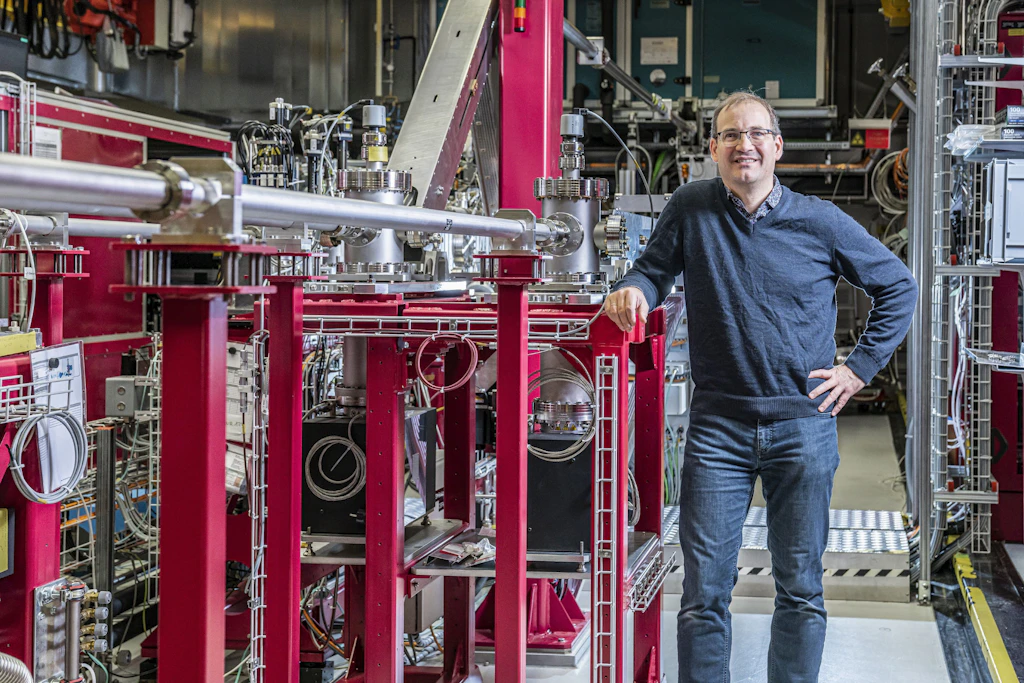
To understand how light-sensitive proteins function, researchers need to observe them at work. This is made possible by time-resolved crystallography at X-ray sources such as the X-ray free-electron laser SwissFEL and the Swiss Light Source SLS. Ultrashort X-ray pulses allow researchers to track the rapid changes that light triggers in proteins – it’s like making a high-resolution film of molecular processes.
“With this we’ve taken structural biology to the next level,” says Jörg Standfuss from the PSI Center for Life Sciences, who specialises in such investigations. “We can track in detail what happens in the protein after the light pulse and thus better understand how these light-sensitive proteins function.”
In this way Standfuss and his team are also investigating channelrhodopsins from single-celled organisms – the protein family that gave rise to optogenetics. By means of time-resolved crystallography the PSI team examined, for example, a channelrhodopsin from the research of Nobel laureate Peter Hegemann. This brings us full circle from the molecular foundations of optogenetics to today’s research at PSI.
Text: Paul Scherrer Institute PSI/Brigitte Osterath
About PSI
The Paul Scherrer Institute PSI is the largest research institute for natural and engineering sciences in Switzerland. It is the central location of Switzerland’s large research facilities, available to both the scientific community and industry. Its research spans future technologies, energy and climate, health innovation and fundamentals of nature. The annual budget is CHF 450 million. PSI employs 2300 people; around a quarter of these are postdoctoral researchers, PhD students or apprentices. PSI is part of the ETH Domain, which also includes ETH Zurich and ETH Lausanne, as well as the other federal research institutes Empa, Eawag and WSL.
Contact
Prof. Dr. Gebhard Schertler
PSI Center for Life Sciences
Paul Scherrer Institute PSI
+41 56 310 42 65
gebhard.schertler@psi.ch
[English, German]
Prof. Dr. Jörg Standfuss
PSI Center for Life Sciences
Paul Scherrer Institute PSI
+41 56 310 25 86
joerg.standfuss@psi.ch
[German, English]